
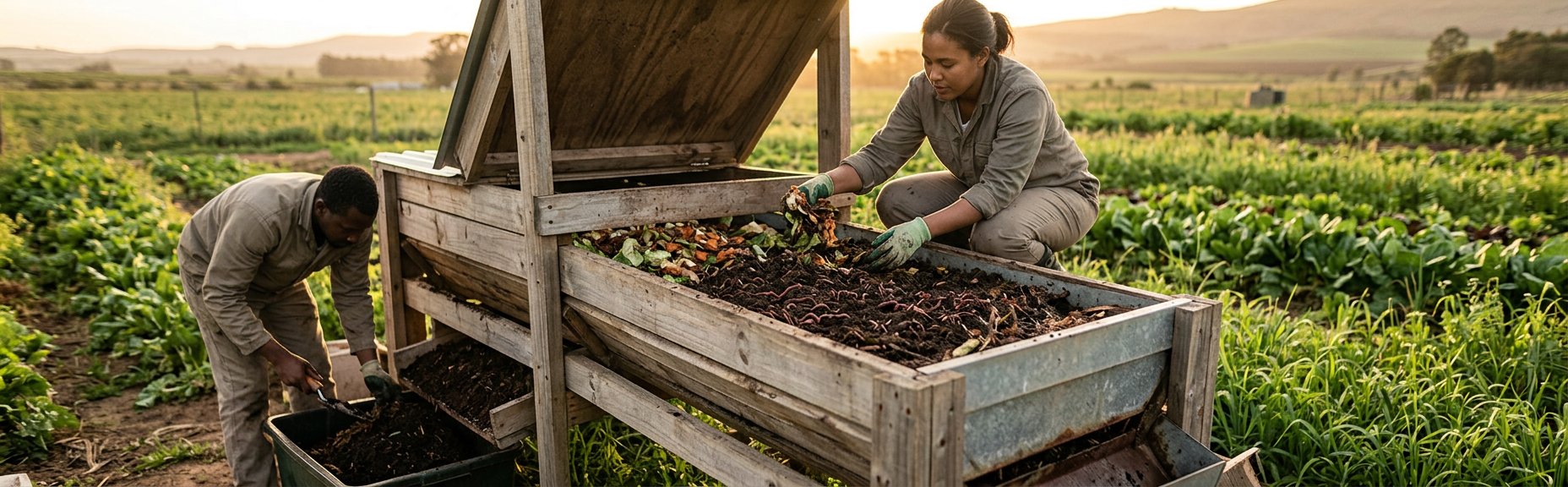
Feed at the top, harvest below—but manage every layer
A flow-through worm farm is attractive because feeding and harvesting happen in different parts of the bed. Prepared material is added at the top. Worms and microbes work through the active zone. More processed material is removed from below. In principle, the bed can continue operating without being emptied for every harvest.
That simple description can hide important design choices. The support structure, bed depth, harvest mechanism, access, drainage, shade, feeding pattern and maintenance plan all affect how the system behaves. “Continuous” does not mean unattended, and a bottom opening does not guarantee that finished, worm-free vermicompost will fall out on schedule.
Green Earth Concepts' Commercial Worm Farms service uses site assessment and modular design to fit the system to real feedstock and operations. This guide explains what to inspect before choosing a flow-through format and how to distinguish a useful operating principle from a capacity promise.
How the vertical process is intended to work
Composting worms are surface dwellers associated with decaying organic material. Oregon State University Extension describes how worms in stacking systems follow fresh food upward, leaving processed material in lower trays. A commercial flow-through bed applies a related vertical logic in a larger, often deeper structure: new feed and bedding are placed on top while older material moves downward over time.
The upper zone should offer an appropriate moist, oxygenated habitat and approved, non-heating feed. Beneath it, material progresses through different stages of decomposition. The lower support holds the bed while allowing a scraper, breaker bar, rake or other designed mechanism to remove a controlled layer. The precise hardware differs, so operators need manufacturer-specific training.
The material does not move like liquid in a pipe. Compaction, channels, uneven feeding, excessive moisture, structural bedding and harvest technique can cause different parts of the bed to mature at different rates. Worms and cocoons can also be present lower than expected. Every harvest therefore needs observation and a plan to recover living stock.
Flow-through design may reduce the disruption of emptying an entire bed, but it adds a mechanical and access interface below the biology. The operator must reach the harvest zone safely, manage falling material, inspect support components and keep tools from damaging the system.

What to inspect in a flow-through design
| Design area | Useful feature | Question to ask |
|---|---|---|
| Top access | Even, ergonomic access for controlled feed placement | Can staff reach the whole surface without climbing or overreaching? |
| Weather protection | Shade and rain control suited to the local site | How will sun, wind-driven rain and stormwater be managed? |
| Bed structure | Durable, cleanable materials and safe load support | Who has verified the structural load and corrosion risk? |
| Lower support | Holds the active mass while enabling controlled harvest | How is bridging, clogging or accidental release handled? |
| Harvest access | Protected workspace for tool use and collection | Can the task be performed without unsafe posture or falling-material exposure? |
| Drainage and moisture | No pooling, uncontrolled discharge or inaccessible wet zones | Where does excess water go, and how are conditions checked across the bed? |
| Modularity | Clear isolation, service and expansion logic | Can one module be maintained without destabilising the others? |

Cutaway view of a flow-through worm bed from top feed layer to bottom harvest zone
The operating rhythm matters more than the label
A reliable rhythm begins with feed acceptance. Staff inspect and prepare approved material, add it in shallow, distributed zones and record where and how much was fed. They check internal temperature, moisture distribution, odour, pests and surface activity before deciding on the next addition. A fixed calendar feed should never override abnormal bed conditions.
Harvesting should also be staged. Remove a small lower layer, inspect texture and recognisable material, recover worms and cocoons where practical, and keep the batch identified. The full commercial vermicompost harvesting guide addresses timing and worm retention. Do not market the output from appearance alone; intended use may require maturity or laboratory checks.
Finally, clean and inspect the harvesting interface. Check supports, moving parts, guards, corrosion, access and any areas where material has bridged. Record maintenance and changes. A bed that becomes difficult to harvest can encourage aggressive tool use, deferred maintenance and large disruptive removals.
Is a flow-through system a sensible fit?
- The site has a consistent approved feedstock and preparation routine.
- Operators can access the full top surface and lower harvest zone safely.
- Shade, rain, wind, water and drainage have been designed for the site.
- The team can monitor zones and resist feeding by calendar alone.
- Harvest tools, support components and guards can be inspected and maintained.
- There is space for reception, preparation, harvest and batch storage.
- Expansion will follow written stability gates.
- The purchase decision depends only on advertised daily throughput.

Assess the site before choosing the mechanism
A Green Earth Concepts site assessment can compare flow-through and other configurations against measured feedstock, access, climate exposure, staffing and output needs. Ask for a design recommendation and commissioning plan, not only a unit price.
Flow-through worm farm questions
Does a flow-through worm farm run continuously?
It can receive feed and yield harvests on a repeated cycle without full emptying, but it still needs pauses, observation, maintenance and contingency. Continuous-flow describes the operating principle, not uninterrupted automatic performance.
Will the worms stay only at the top?
Worms often follow favourable food and habitat near the upper zone, but distribution varies with moisture, temperature, feed and bed structure. Inspect every harvest and recover worms or cocoons where appropriate.
Is all material removed from the bottom finished vermicompost?
Not automatically. Harvested material may vary across the bed and can contain recognisable feed, bedding, worms or cocoons. Use defined maturity, screening, sampling and end-use checks.
Can a flow-through bed be automated?
Some feeding or harvesting tasks may be mechanised, but automation does not replace feed acceptance, biological monitoring, safety controls and maintenance. Assess equipment and training for the actual site.
How do we expand capacity?
Prove stable operations at the current module first. The guide to scaling worm farms in modules sets gates for feedstock, people, process, outputs and contingency.
A useful design separates work without hiding it
Flow-through beds separate top feeding from lower harvesting and can support modular operations. Their value comes from accessible, controlled work zones—not from the idea that gravity and worms remove the need for management.
Inspect the structure, operate the layers deliberately, harvest in small verified batches and expand only after the present module is stable. That is how the design principle becomes a maintainable system rather than an attractive box.