

Healthy starter stock cannot fix an unhealthy system
Red wigglers are often the first item on a new worm-farm shopping list. They should be one of the last. Before live worms arrive, the site needs suitable bedding, protected conditions, accepted feedstock, a trained operator and a plan for checking what happens during the first days. Buying a larger population cannot compensate for a hot bed, waterlogging, contamination or neglect.
For a South African commercial project, sourcing is also more than finding the lowest price per kilogram. Species identity, transport time, the amount of bedding included, recent feeding, condition on dispatch and support after delivery all affect the start. Green Earth Concepts designs Commercial Worm Farms around the full operation rather than treating worms as equipment.
This guide focuses on the composting worms commonly called red wigglers, supplier due diligence and a cautious start-up. It does not set a universal stocking rate. Stocking depends on system design, usable feedstock, habitat volume, climate control and how the operator will phase feeding.
Why species and ecological habit matter
Oregon State University Extension identifies Eisenia fetida as a commonly used red wiggler for vermicomposting. Utah State University Extension also notes that common names such as red worm, manure worm and tiger worm may be used for more than one species, including E. fetida and E. andrei. That is why a supplier should provide a scientific name rather than relying only on a colour or nickname.
Red wigglers are epigeic worms: they live near the surface in rich decaying organic material. They are not the same as deep-burrowing garden earthworms. Their surface-dwelling habit suits shallow, oxygenated bedding and repeated additions of prepared organic material. Moving random worms from soil into a commercial bed is therefore not a reliable sourcing method and may introduce the wrong species or unwanted material.
Worms exchange gases through moist skin, so the habitat must hold moisture without displacing the air in pore spaces. They are also affected by temperature inside the bedding. Extension ranges can orient an operator, but they are not a substitute for the system supplier's operating plan and site measurements. South African shade, wind, humidity and daily temperature swings can make the bed differ sharply from ambient air.
Species identity does not prove quality. A correctly named batch can still arrive stressed, overheated, dried, waterlogged or mixed with unsuitable bedding. Procurement must therefore combine documentary questions with an arrival inspection and a small, observed introduction.
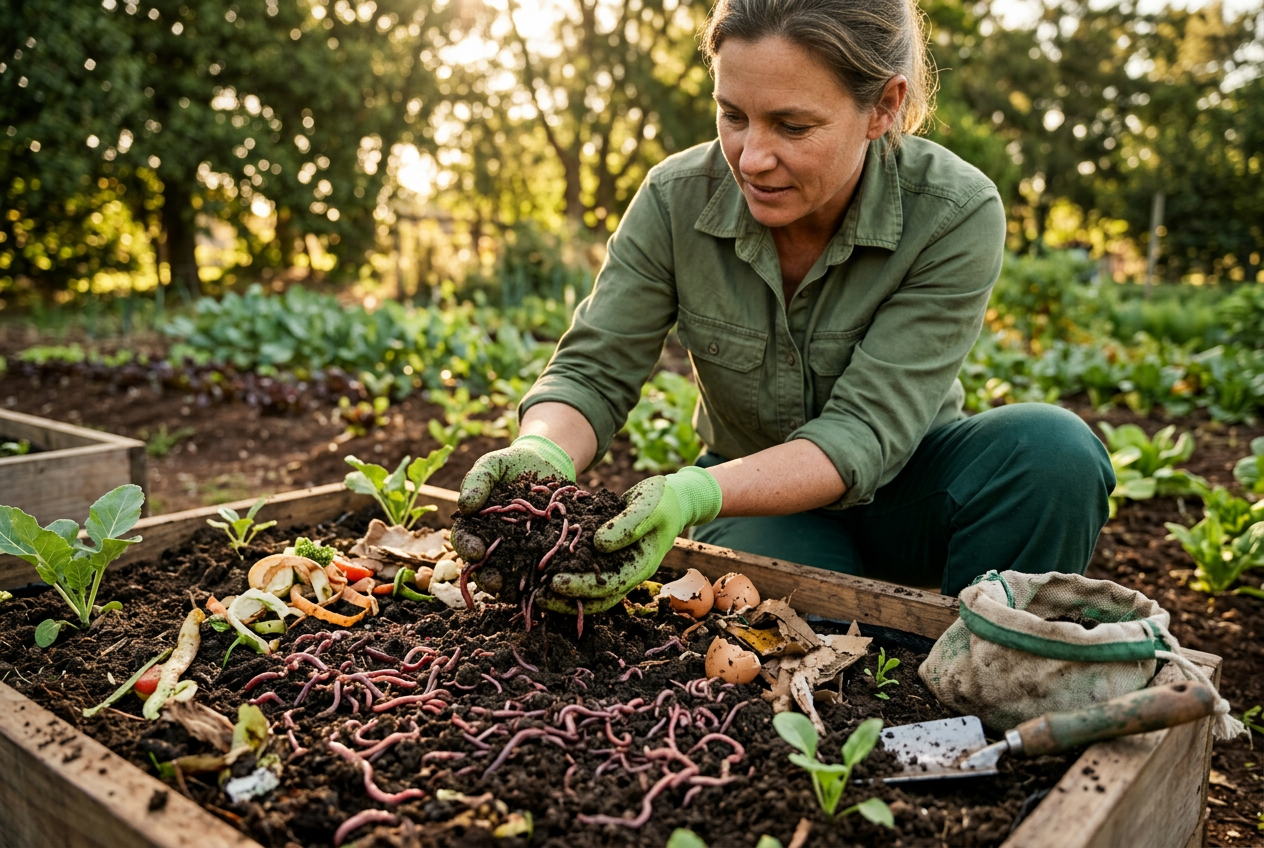
Questions to ask a worm supplier before ordering
- What scientific species name do you supply, and how do you verify it?
- Is the quoted quantity live-worm mass, total worms-plus-bedding mass, an estimate or a count?
- What bedding and recent feed will travel with the worms?
- When will the worms be packed, dispatched and expected to arrive?
- How are heat, cold, ventilation and moisture managed during transport?
- What should the receiver do immediately if delivery is delayed or damaged?
- What evidence, replacement policy and post-delivery support are available?
- Are there any source-material, chemical or pest concerns the buyer should know?
- The supplier uses only common names and will not discuss the species.
- The sales claim assumes a fixed processing rate or guaranteed population growth.
A low-stress arrival and acclimatisation routine
- 01
Prepare the habitat before dispatch
Set up moist, airy bedding in a protected section of the actual system. Check internal temperature, drainage and water distribution. Do not create the habitat while live stock waits in a closed transport container.
- 02
Receive into shade and record the delivery
Note arrival time, package condition, dispatch details and unusual heat, cold, liquid, odour or damage. Photograph the closed package and label before opening. If the shipment appears seriously compromised, contact the supplier before improvising.
- 03
Inspect a representative sample
Open gently in a shaded, ventilated area. Look for movement after a short settling period, mixed sizes, suitable moist bedding and obvious contamination. Do not conclude that still worms are dead immediately after transport, and do not expose them to hot sun to test movement.
- 04
Introduce the stock to prepared bedding
Place the worms and their compatible transport bedding on the prepared surface and allow them to move into the habitat. Avoid a large fresh feed on arrival. If they remain balled up or attempt to escape, check habitat conditions rather than forcing them down.
- 05
Observe before increasing feed
Start with a small approved feed zone and mark it. Check whether the material is changing without heat, sour odour, saturation or escape behaviour. Increase only when the previous addition is largely being processed and the bed remains stable.
- 06
Escalate abnormal behaviour
Persistent escape, mass inactivity, strong odour or rapid heating calls for a pause and investigation. Use the guides to worm-farm moisture control and South African temperature management, and contact a competent adviser if the cause is unclear.
Protect the biology during procurement and start-up
Do
- Do choose the species and supplier before agreeing a delivery date.
- Do prepare a stable refuge with suitable bedding first.
- Do retain supplier, batch, transport and arrival records.
- Do phase feeding according to observed processing.
- Do train a backup operator before the worms arrive.
Don't
- Don't harvest unknown worms from ordinary garden soil.
- Don't unpack live stock in direct sun or a hot vehicle bay.
- Don't wash worms free of all familiar transport bedding.
- Don't add an entire week's waste on day one.
- Don't promise performance from worm mass alone.

Prepare the system before purchasing live stock
A Green Earth Concepts site assessment can review the habitat, feedstock, water, shade, workflow and training needs before stocking. Bring supplier information and proposed delivery timing so commissioning can be planned around the biology.
Red wiggler sourcing questions
Are red wigglers and ordinary earthworms the same?
No. Red wigglers used for vermicomposting are surface-dwelling composting worms. Many familiar garden worms live and feed differently in mineral soil and are not suitable substitutes for a managed worm bed.
Should I buy worms by number or by weight?
Either description can be misleading unless the supplier defines the method. Ask whether bedding is included, how the quantity was estimated, what life stages are present and how the batch was packed. Use that information with the system design rather than as a standalone capacity claim.
Can worms be couriered across South Africa?
They may be transported by an experienced supplier, but journey time, weather, packaging, ventilation, moisture and handover all matter. Agree dispatch timing and a delay plan before shipment; avoid leaving live stock in a depot or closed vehicle.
How soon should I feed after arrival?
Use the supplier's site-specific instructions and observe the worms in prepared bedding first. A small approved trial feed is safer than a large load. Increase only when the habitat remains stable and earlier material is being processed.
What if worms try to leave the bed?
Treat persistent escape as a warning. Check internal temperature, moisture distribution, oxygen, recent feed, vibration and possible contamination. Pause new feed while investigating rather than using light as the only long-term control.
Buy a supported population, not a promise
The best red wiggler purchase is traceable, appropriately transported and introduced into a prepared habitat by people who know what to observe. Scientific identity matters, but so do bedding, condition, records and support.
Prepare first, receive carefully and feed gradually. That approach will not guarantee a result, but it gives the worms and the operating team a far better starting point than treating a live population as another line item on an equipment order.