
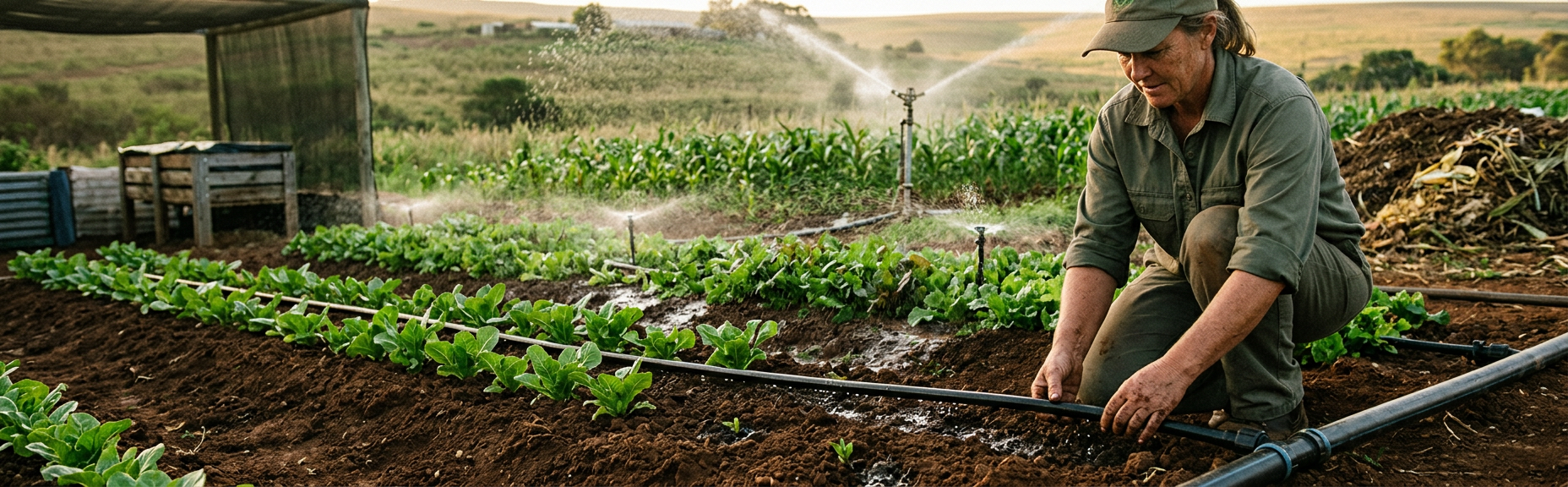
The wrong irrigation method can waste water very efficiently
A neat line of drippers can under-water a broad lawn. A powerful sprinkler can throw half its pattern into a Highveld wind. A hose can be the most sensible tool for six containers and an exhausting liability across a market garden. The hardware is not efficient or inefficient on its own; it becomes suitable only when it matches the crop, root zone, soil, water source and people who operate it.
That is the useful way to compare irrigation methods in South Africa. Start with the job each zone must do, then test whether the source can supply it under working conditions. This guide compares drip, micro-spray, conventional sprinkler and careful manual watering without pretending that one method wins everywhere.
For a system designed around measured site conditions, explore water-wise irrigation system design.
Compare the whole watering job, not the product label
Six questions shape the choice. What root area must be wetted? How quickly can the soil accept water? Does wind distort spray? What flow and pressure remain while the zone runs? How often will crops or containers move? Who will inspect, flush, adjust and repair the system? A low-flow product can still perform badly when spacing, pressure, scheduling or maintenance is wrong.
Drip applies water at discrete points or along a line and is useful where rows, beds or individual plants can be matched to a known wetting pattern. Micro-sprays wet a broader surface and may suit dense groundcover, nursery areas or tree basins, but wind and evaporation matter. Sprinklers can cover lawns and field areas effectively when spacing, pressure and nozzle selection create acceptable uniformity. Manual watering gives human judgement and flexibility at small scale, yet consistency and labour become limiting as the site grows.
Do not choose before separating unlike plants. A lawn, vegetable bed, young orchard and established indigenous shrub border rarely need the same application method or schedule. The practical next step is an irrigation site assessment that maps those differences.
Also compare the cost of ownership, not only the purchase price. A method that needs frequent hand-watering may demand more labour; a highly automated system needs protected controls, spares and people who can diagnose it. The Department of Water and Sanitation's water-use-efficiency guidance reinforces the wider need to manage scarce water deliberately, but efficiency on one property must still be demonstrated through measured application, plant response and maintenance records.
For the next practical decision, continue with Irrigation Site Assessment: The Checklist Before You Buy a Single Fitting.
Method-by-method decision table
| Method | Often suits | Watch closely | Strong reason to reject |
|---|---|---|---|
| Drip line or point emitters | Rows, beds, hedges and individual plants with predictable positions | Filtration, pressure control, flushing, hidden blockages and the soil wetting pattern | The planted area moves frequently or one line cannot wet the required root area |
| Micro-spray or bubbler | Trees, shrubs, nurseries and zones needing a broader wetted surface | Wind, overlap, runoff, evaporation and plant interference | Spray will wet paths, structures or people, or wind dominates the site |
| Sprinklers | Lawns and suitable field or landscape blocks | Head-to-head spacing, matched nozzles, working pressure, wind and overspray | The shape is too fragmented or water cannot be kept off buildings and hard surfaces |
| Manual hose or watering can | Small, changing collections and spot watering | Operator judgement, time, repeatability, hose damage and safe access | The area is too large or care cannot be delivered reliably during absence |
Choose on evidence
Do
- Group plants with similar water needs before selecting hardware.
- Measure usable flow and working pressure at representative times.
- Check soil infiltration and the actual wetting pattern below the surface.
- Include filtration, isolation, flushing and maintenance access in the comparison.
Don't
- Assume drip automatically means the lowest water use.
- Mix sprinklers and drippers on one zone without hydraulic design.
- Select from catalogue radius or flow figures without checking site conditions.
- Promise a saving percentage before a baseline and comparable result exist.
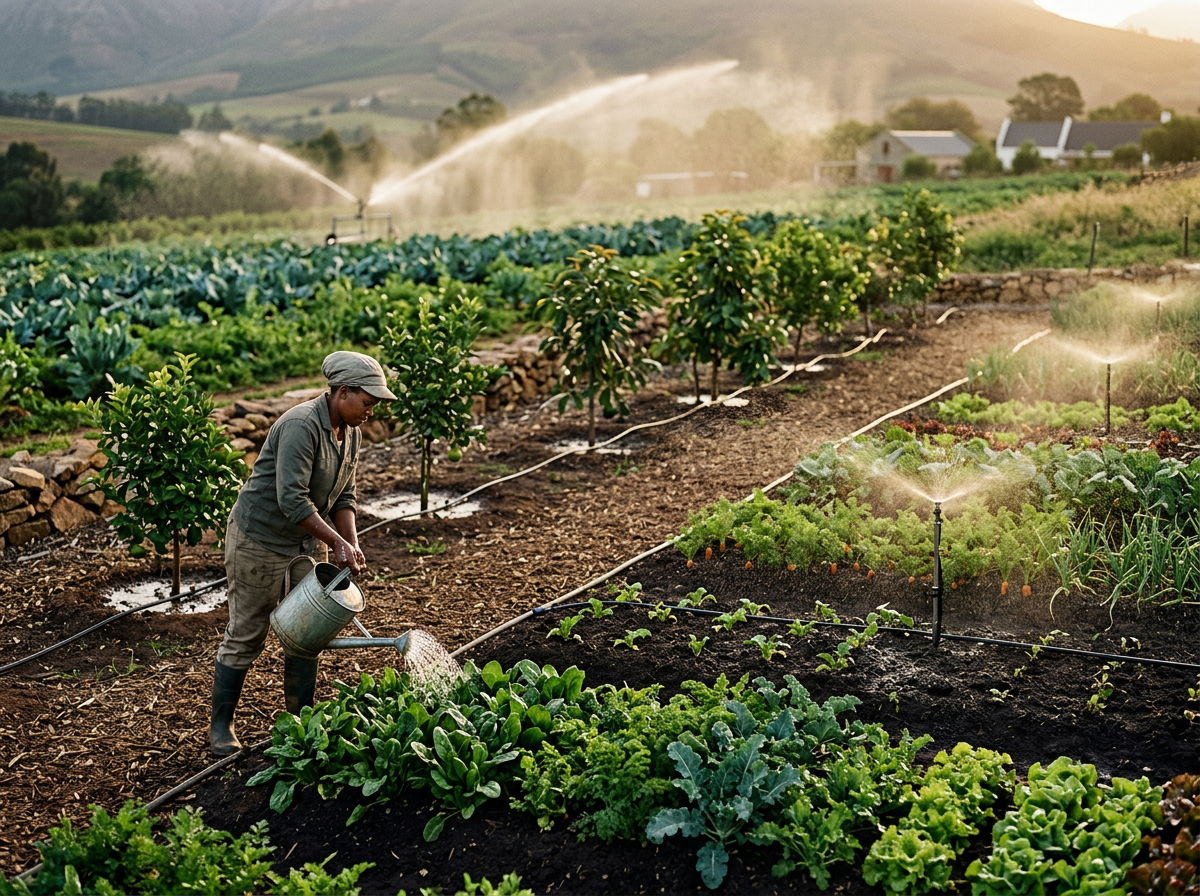
Drip, micro-spray, sprinkler and manual irrigation used in four different suitable landscape zones
One property may need four answers
Picture a smallholding with a lawn near the house, a vegetable garden, a row of young fruit trees and mobile herb pots. The lawn may justify well-spaced sprinklers; vegetables may suit regulated drip laterals; trees may need expandable micro-irrigation; and pots may remain manual until their positions stabilise. Hydrozoning turns that mixed site into manageable decisions.
The image should show appropriate uses side by side, not imply equal run times. Add labels after production so each method, zone and maintenance point can be checked for accuracy.
If the site depends on frequent human watering, compare the control and labour trade-offs in manual versus automated irrigation.
A five-minute shortlist
- I can describe the plant type, root area and growth stage in each zone.
- I know the soil texture or infiltration behaviour and where runoff collects.
- I have measured source flow and pressure while water is moving.
- I have recorded wind, slope, shade, paths and no-spray boundaries.
- Someone has time and skill to inspect the chosen method.
- I am choosing mainly because a product is described as water-saving.
Choose the method that can be operated well
- Match irrigation to the root zone, not to a marketing category.
- Separate plants and methods that need different schedules.
- Treat pressure, flow, water quality and maintenance as design inputs.
- Verify performance in the soil and on the surface after installation.

Turn the comparison into a site plan
Green Earth Concepts can assess the water source, landscape, crops, soil, elevation, exposure and operating capacity before recommending methods and zones. The outcome is a practical route from source to root zone, including the checks the team must keep doing after installation.
Irrigation-method questions
Is drip irrigation always the most water-efficient option?
No. Drip can reduce unnecessary surface wetting when it is correctly filtered, regulated, spaced and scheduled, but blocked emitters, poor wetting patterns, leaks or excessive run time can waste water and stress plants. Suitability must be assessed per zone.
Can sprinklers and drip share one valve?
They usually have different pressure, flow and run-time behaviour. Combining them can make both difficult to manage. A designer should check the components and hydraulics; separate zones are commonly the clearer solution.
When is manual watering a good choice?
It can be sensible for a small, changing collection, establishment watering or targeted checks. It becomes risky when the area, labour demand or need for repeatability exceeds what the responsible person can deliver.
There is no universal winner—only a better match
Efficient irrigation is a relationship between design and management. Choose the simplest combination that can deliver suitable water uniformly, avoid boundaries, survive local conditions and be maintained by the people on site. Then measure it under real operation before calling it efficient.