

A calendar tells you when; a plan tells you what must change
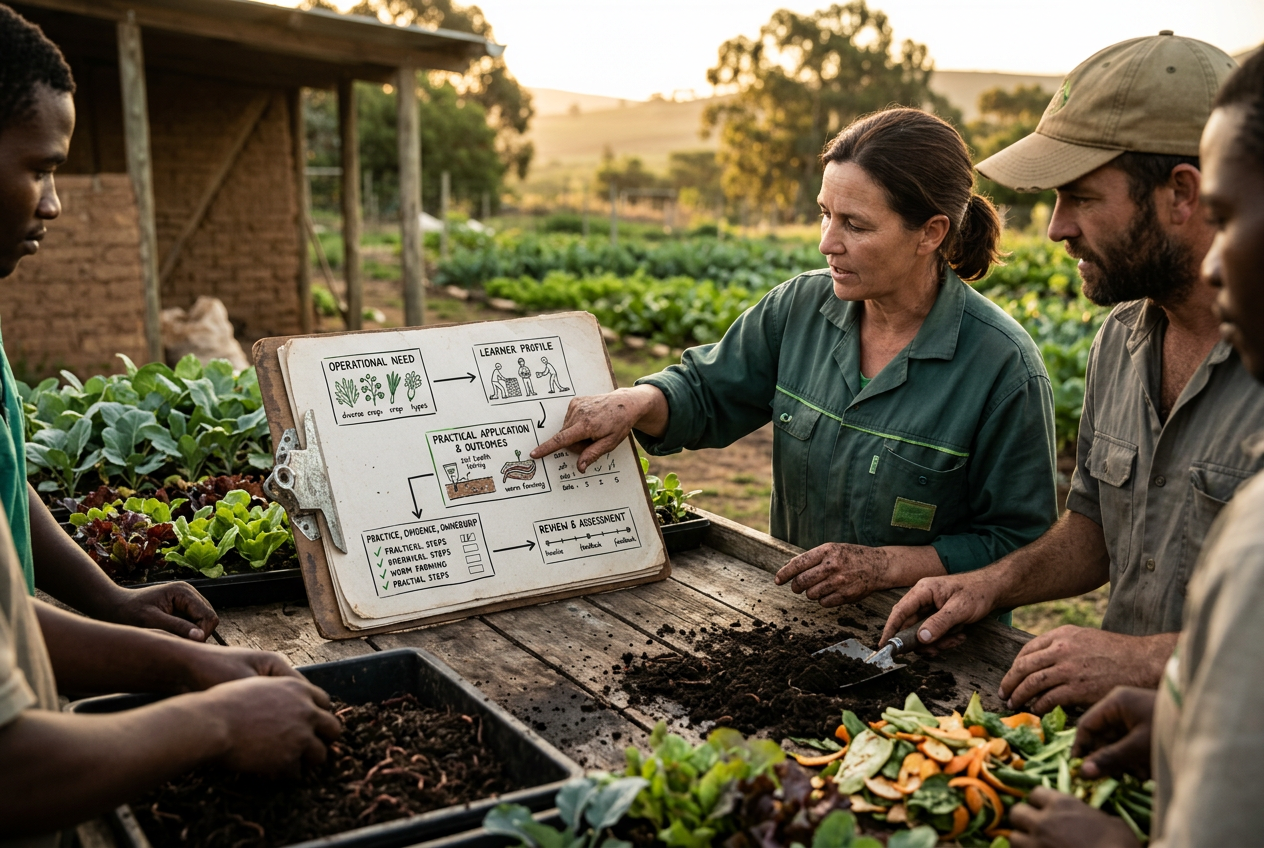
Putting four workshops on a calendar does not create capability. A working training plan connects an operational need to specific people, tasks they must practise, evidence of safe performance and reinforcement after the facilitator leaves. It also survives shifts, peak seasons, weather and staff turnover.
Use a one-page core plan supported by task sheets and evidence records. If managers cannot see ownership, time and follow-up at a glance, the programme is likely to become an event rather than a change in routine.
Green Earth Concepts develops practical training and support around installed and operating environmental systems.
Seven fields make the plan operational
Write an outcome as a visible performance: the learner can inspect and flush a drip zone, accept or reject a feedstock load, or record a worm-bed condition and escalate an abnormal result. Name the learner group by role, not a vague label such as staff. Describe the real practice setting, tools and safe boundaries.
Define evidence before delivery: direct observation, a completed record, an explained decision or a supervised response to a scenario. Name who judges the evidence and what standard they use. Then schedule initial learning, supported workplace practice and a follow-up check. Attendance is an input; demonstrated performance is the stronger signal.
The plan should be based on a training needs assessment and measured beyond attendance using environmental training impact.
A useful plan also names the transfer conditions. State where practice will happen, which real materials learners may handle, what must be simulated for safety and who will release people from normal duties. Schedule around heat, harvest, collection rounds, irrigation windows and transport rather than assuming a classroom timetable is neutral. If a task must be performed at dawn or during a live delivery, the learning plan should include that context or explain how equivalent evidence will be produced.
Add a reinforcement line for every priority outcome. The supervisor may observe one task during the first week, a peer may use a visual check card during the next cycle, and the facilitator may review records after a month. Name the evidence, date and person responsible. This turns follow-up from a hopeful promise into an operating commitment and makes it easier to distinguish fading confidence from a system problem that training never addressed.
Keep the document usable on one page by linking detail rather than cramming it into tiny text. Store the risk assessment, attendance arrangements, equipment list, language glossary and assessment instruments as controlled attachments. Put version, owner and review date on the plan itself. When an operating procedure changes, the owner can trace which outcome, visual aid and trainer briefing needs revision. That small control prevents a technically polished course from teaching yesterday's method and gives supervisors one reliable reference for preparation, delivery and follow-up.
One-page training plan
| Field | Question | Example evidence |
|---|---|---|
| Operational need | What result or risk must change? | Repeated blocked emitters are detected earlier |
| Outcome | What will the learner demonstrate? | Inspects filter and explains clean-or-escalate decision |
| Learners | Which roles need which depth? | Operators practise; supervisors verify and coach |
| Method | How will people observe, try and reflect? | Demonstration, paired practice and fault scenario |
| Resources | What site, tools, language and access support is required? | Real filter, visual SOP, safe isolation and bilingual terms |
| Evidence | What proves acceptable performance? | Observed task checklist and accurate record |
| Owner and timing | Who arranges, reinforces and reviews? | Site manager reviews after 7 and 30 days |
Build the plan in the right order
- 01
Confirm the need
Use observed task evidence and system records. Remove issues that require repair, design or management action rather than learning alone.
- 02
Write demonstrable outcomes
Use an action, condition and acceptable evidence. Avoid outcomes such as understand irrigation unless the learner must explain or perform a defined decision.
- 03
Segment roles
Operators, supervisors, cleaners, managers and community coordinators may need different practice and authority. Do not give everyone the same slide deck.
- 04
Plan practice before presentation
Reserve the system, tools, materials and safe time needed for each learner to try the task and receive feedback.
- 05
Design language and visual support
Map preferred languages, use plain terms and pictures that match the site, and brief interpreters or bilingual peers without making them responsible for technical accuracy alone.
- 06
Choose evidence and assessor
Agree who observes performance, how consistency is supported and what happens when the learner is not yet ready to work unsupervised.
- 07
Schedule reinforcement
Add supervisor prompts, toolbox refreshers, record reviews and follow-up observation to the plan. Skill retention is an operating responsibility.
Stress-test the plan against the workday
- Every outcome names an observable action or decision.
- Every learner gets relevant practice, not only a demonstration.
- Shift, seasonal and language constraints have owners.
- Evidence is safe, transparent and proportionate to the task.
- Supervisors know how to reinforce the new routine.
- The plan includes absence, turnover and refresher needs.
- Success is defined only as attendance or satisfaction.
Training-plan questions
How long should a training plan cover?
Cover the period needed for initial learning, workplace practice and evidence of retention. A simple task may need a short cycle; a seasonal farming skill may need observation across a longer production period.
Can one plan cover several sites?
A shared framework can help, but tasks, systems, languages, risks and local routines must be checked per site. Keep site-specific adaptations visible.
Does a completion certificate prove competence?
Not by itself. A certificate may record participation or an approved assessment, depending on the programme. State exactly what was evaluated and do not imply accreditation that the provider or course does not hold.

Build a plan around your system and team
Green Earth Concepts can turn site evidence into role-based outcomes, practical delivery and follow-up. Bring the system, learner roles, language context and the result you need to protect.
Plan the transfer, not only the session
- Connect every activity to an operational outcome.
- Give each role relevant practice and evidence.
- Design for real shifts, languages and resources.
- Name the manager who reinforces the skill.
A good plan survives the facilitator's departure
If the plan ends at the workshop door, it is incomplete. Connect learning to supervised practice, workplace evidence and a manager who can keep the routine alive when the next busy day arrives.