
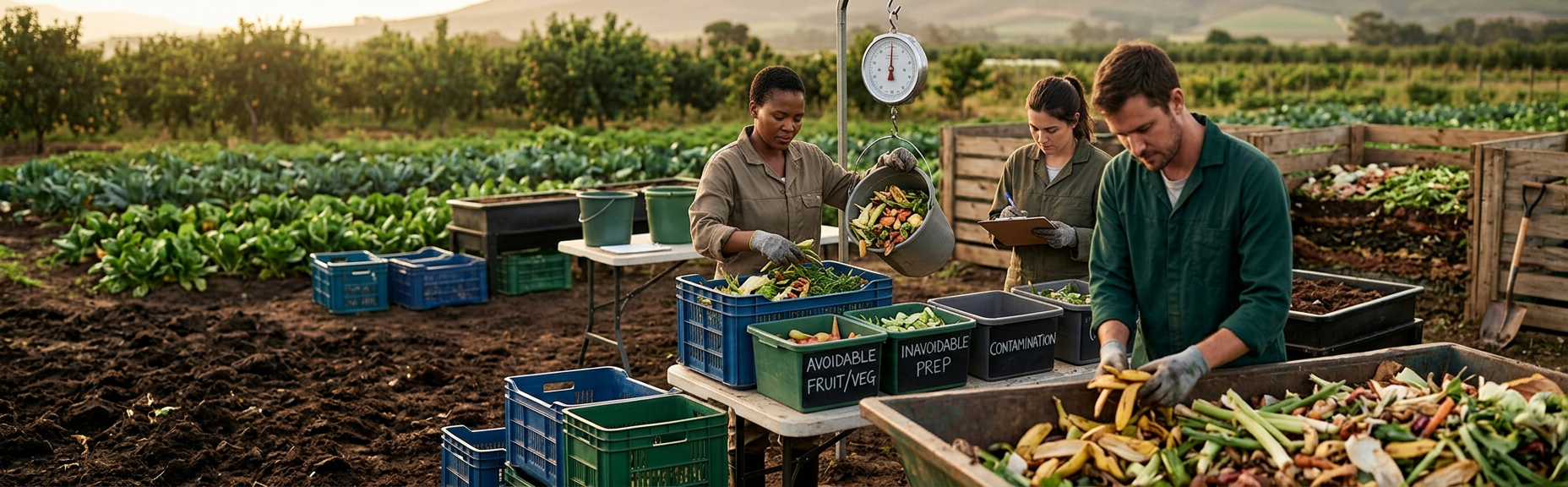
A week reveals what one skip inspection cannot
One skip inspection tells you what was thrown away at one moment. Seven days can reveal where, when and why it happened. A breakfast buffet, school lunch, supermarket produce department, estate garden team and farm packhouse all have peaks, quiet periods, handovers and different types of organic material. A useful audit follows those patterns instead of treating the site's waste as one anonymous total.
The aim is not to create a perfect national waste study. It is to produce a safe, repeatable baseline that management and operators can act on: which streams are largest, which are avoidable, where contamination enters, which days or shifts create peaks and what the current storage or collection system must handle. That evidence is the starting point for a credible organic waste recycling programme.
Define the audit before opening a bin
Write a one-page scope. State the sites, departments, streams, dates, operating hours and decisions the audit must support. Decide whether you are measuring preparation waste, spoilage, plate waste, garden material, packaged stock or all of them as separate categories. Identify known peak days, deliveries, events, school closures, load-shedding effects or seasonal work that may distort a supposedly normal week.
Name an audit lead, a safety lead, data recorders and department contacts. Agree where material will be intercepted, who may handle it, which PPE and hygiene controls are required, how containers will be moved, and where samples or separated categories may be placed without blocking work, contaminating food areas or exposing people. Notify staff that the purpose is to understand the system, not to catch individuals making mistakes.
Do not manually sort unknown, chemical, sanitary, healthcare risk, sharp, decomposing animal or otherwise hazardous material. Do not reach into compactors or uncontrolled skips. Stop if bags leak, sharps are visible, fumes or strong unknown odours are present, pests are active in a way that creates exposure, or the planned area cannot be made safe. The employer's risk assessment and occupational-health controls come first.
Prepare the audit kit and controls
<p>Use equipment appropriate to the site and approved by the safety lead. A typical controlled audit may need:</p>
- Calibrated or checked scale with a suitable capacity — Creates comparable mass data without unsafe overloading.
- Known-volume containers or liners — Supports a documented volume method when weighing is not practicable.
- Clear category labels and waterproof marker — Prevents categories from merging during a busy period.
- Task-appropriate gloves, apron, footwear and any other required PPE — Protects staff according to the site's risk assessment.
- Washable table or approved audit surface and cleaning materials — Keeps the audit area controlled and recoverable after use.
- Tongs or tools approved for the task — Reduces direct contact where visual checking is allowed.
- Station sheets, clipboard or protected digital form — Captures source, shift, category, quantity, cause and notes consistently.
- Spill, exposure and emergency procedure — Makes the stop-and-escalate route clear before an incident.
- A verified destination for audited material — Ensures the audit does not leave unmanaged waste behind.
Use one station sheet across the week
<p>Record each batch or observation at the point where the stream is intercepted. Keep category definitions on the reverse or in the digital form so different auditors classify the same item consistently.</p><p><em>If accurate weighing requires unsafe lifting or handling, use smaller containers, mechanical assistance or a documented alternative. </em><a href="/blog/measure-organic-waste-without-weighbridge"><em>Measure organic waste without a weighbridge</em></a><em> explains how to improve a volume-based estimate.</em></p>
| Field | What to record | Why it matters |
|---|---|---|
| Date and time | Actual observation time and shift | Connects peaks to service periods, deliveries or collections |
| Source | Department, station, event, bed, store or route | Locates the operational hotspot |
| Category | Preparation offcuts, spoilage, plate waste, garden material, packaged product, other | Separates causes and treatment fit |
| Quantity | Kilograms or documented container volume and fill level | Creates a comparable baseline |
| Avoidability | Potentially avoidable, probably unavoidable, uncertain | Directs prevention questions without pretending the first judgement is final |
| Reason | Forecast error, damage, expiry, trim, overproduction, plate return, process failure, unknown | Connects waste to a management action |
| Contamination | Item and approximate count or agreed observation method | Shows whether the material is usable by the intended pathway |
| Condition | Wet, dry, packaged, mixed, hot, cold, odorous, visibly mouldy, other | Informs storage, safety and characterisation |
| Context note | Event, weather, outage, promotion, menu change, absenteeism, missed collection | Prevents false conclusions from an unusual day |
| Photo reference | Consented, non-identifying file reference if genuinely useful | Supports review without storing unnecessary personal data |
The seven-day audit workflow
- 01
Day 1: Walk the flow and test the method
Start at purchasing or receiving and follow material through storage, preparation, service, clearing, internal collection and the final holding area. Mark every point where material changes owner or container. Run a small controlled test to confirm that category labels, scales, forms and cleaning procedures work. Correct the method before launching the full week.
- 02
Day 2: Establish the normal operating pattern
Collect across all included shifts. Ask staff what normally happens rather than assuming the observed day is typical. Record when containers fill, who replaces them, how often material moves and which categories create uncertainty. Note differences between written procedures and the routine actually used.
- 03
Day 3: Separate avoidable causes from unavoidable residues
Review repeated food items with procurement, stores, kitchen or production leads. A vegetable peel may be largely unavoidable in the current process; sealed expired stock, untouched service trays or repeated overproduction need a cause review. Mark uncertainty instead of forcing a judgement. The aim is to generate testable questions for prevention.
- 04
Day 4: Measure contamination and station friction
Record the main wrong items and trace them to their source. Watch the decision during a peak: is the accepted item clear, is the right bin within reach, does a lid or bag slow the task, is the label visible, and can temporary staff understand it? Contamination is a workflow clue, not proof of laziness.
- 05
Day 5: Capture a peak or special condition
Audit the site's busiest relevant service, delivery, event, harvest or collection period. Record queueing, overflow, rushed handovers and container shortages. If the week has no genuine peak, note that limitation and plan a separate observation rather than scaling a quiet-day average without evidence.
- 06
Day 6: Verify storage, collection and destination data
Compare source measurements with the holding-area count, collection record and service-provider documentation. Investigate gaps: internal spillage, unrecorded bags, material sent to another bin, garden waste collected separately, or a scale entry missed. Confirm the recipient's acceptance criteria and what happens to rejected loads.
- 07
Day 7: Close the loop with operators and management
Summarise the top streams, causes, contamination items, peaks and data limitations. Ask operators whether the pattern matches their experience. Choose three actions: one prevention trial, one separation or workflow correction, and one storage, collection or treatment question for assessment. Assign an owner, due date and remeasurement point.
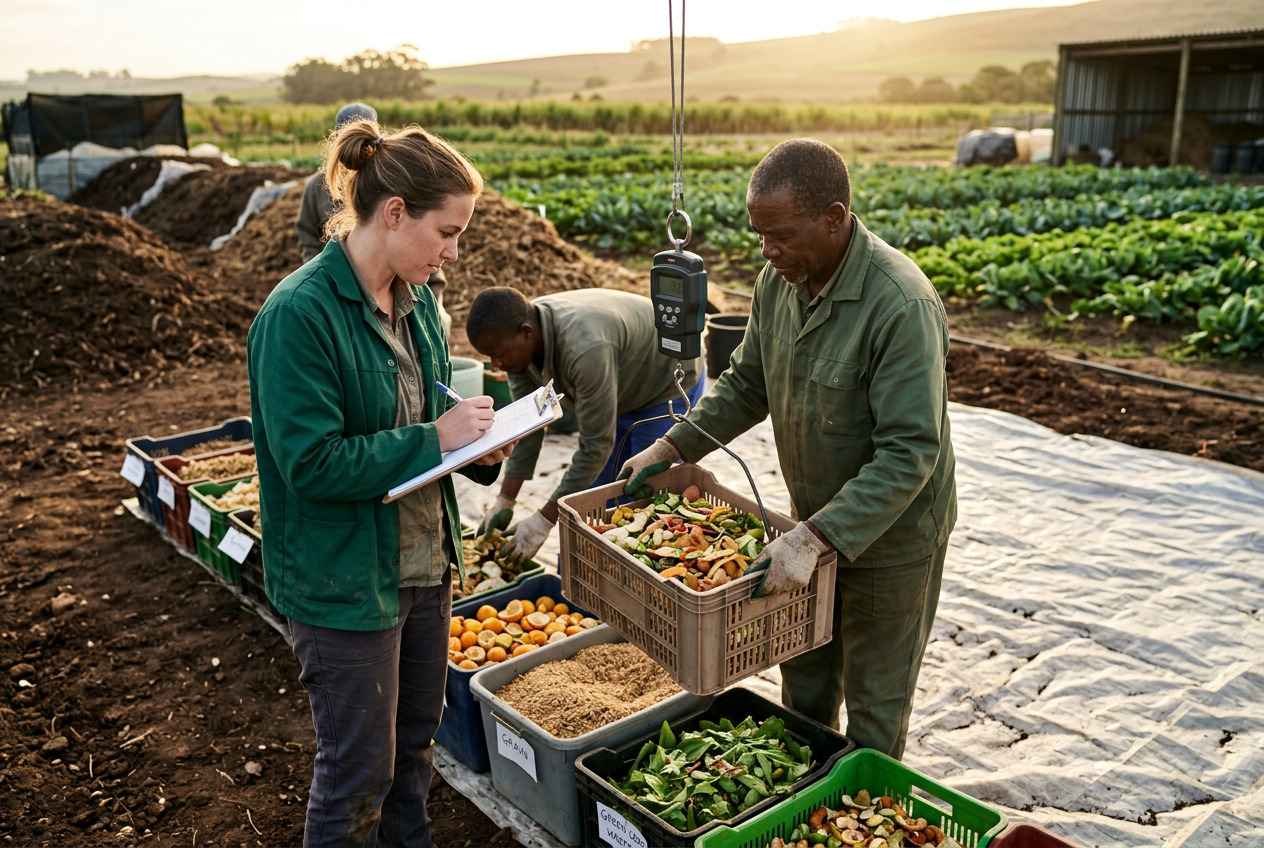
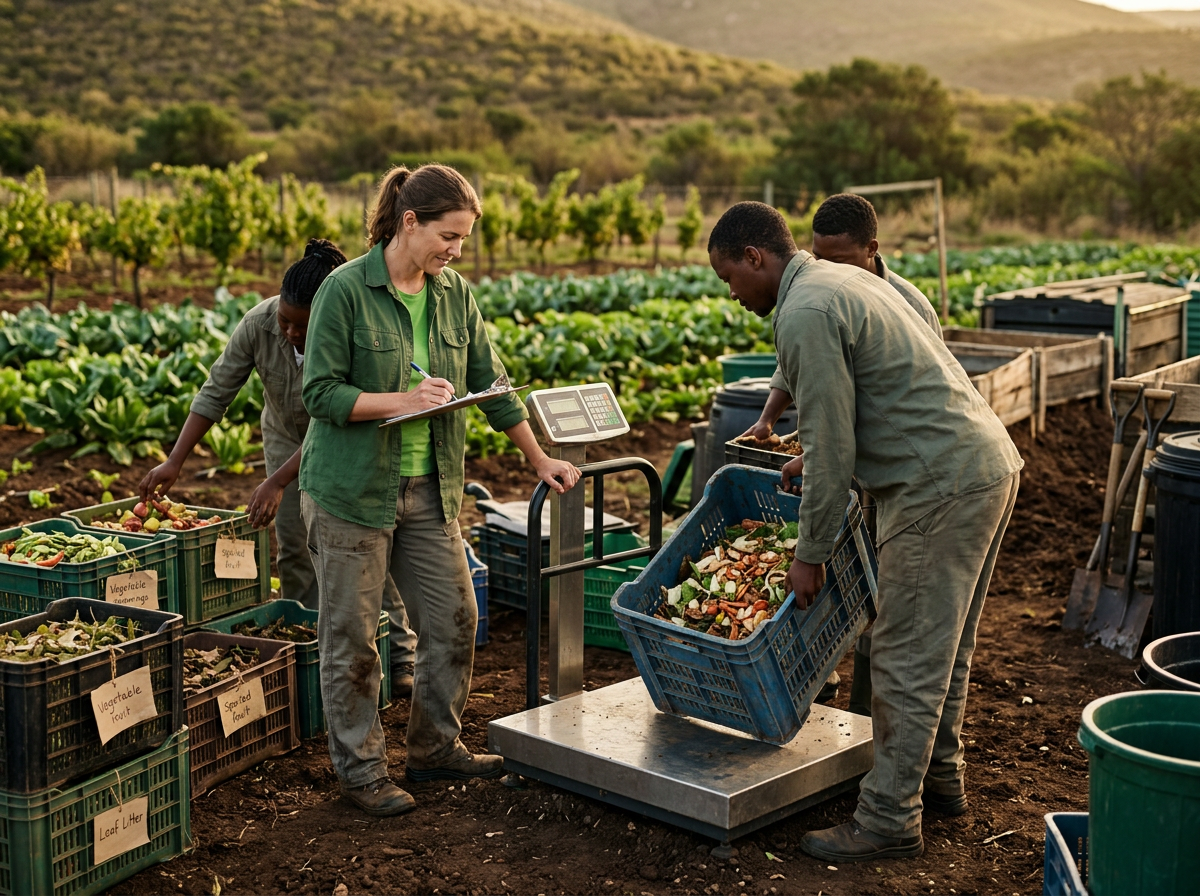
A woman audit lead and site team weigh labelled organic-waste categories at a controlled audit station.
Turn the dataset into a hotspot map
Do not start with a single grand total. Rank categories by source, avoidability, contamination and operational risk. A smaller repeated stream of packaged spoiled stock may deserve faster management action than a larger unavoidable preparation stream. A low-mass contaminant such as film plastic may matter more to processing success than its weight suggests.
Show uncertainty. Mark missing shifts, estimated weights, unusual events and any category that auditors interpreted differently. Then connect each hotspot to the next investigation: procurement, menu or production settings; stock rotation; portioning; staff access to the right station; storage capacity; collection timing; or treatment acceptance. If material properties need deeper review, characterise the organic-waste stream before selecting a system.
Protect the integrity of the audit
<p>A fast baseline is useful only when people can trust how it was collected and interpreted.</p>
Do
- Use written category definitions and train every recorder.
- Tare containers and check the scale method before each session.
- Record zeros as zeros and missing observations as missing.
- Capture peak conditions and explain unusual events.
- Review findings with the people who handle the material.
- Keep photos non-identifying and purpose-limited.
Don't
- Sort unknown or hazardous material to improve a spreadsheet.
- Extrapolate a quiet day across the year without a seasonality note.
- Compare departments using different category rules.
- Treat 'avoidable' as a judgement on an individual worker.
- Claim recycling from material that was merely separated on site.
- Collect names or employee performance details that the audit does not need.
Bring the baseline to the site assessment
Share the audit scope, category definitions, daily sheets, hotspot summary, site photographs with appropriate consent and a note on data limitations. That gives the assessment team a stronger starting point for prevention, separation, storage, collection and treatment decisions.
What a useful audit delivers
- A safe, documented method that another trained person can repeat.
- Quantities linked to sources, shifts, categories and causes.
- Separate views of avoidability, contamination and process fit.
- Clear limitations rather than false precision.
- Three owned actions with a remeasurement date.
- A trigger for assessment when treatment, storage, drainage, nuisance or compliance questions remain.
- A practical next step to design source-separation stations around the observed workflow.
Measure long enough to see the operating pattern
A seven-day audit will not answer every seasonal or compliance question, but it can replace assumptions with a defensible first picture. You should finish knowing which material arises, where it starts, what makes it avoidable or difficult, when peaks occur and which handoffs need attention. Use that picture to run focused trials, then repeat the same measurement method. Improvement becomes credible when the next week can be compared with the first.