

One bucket can prevent a very expensive guess
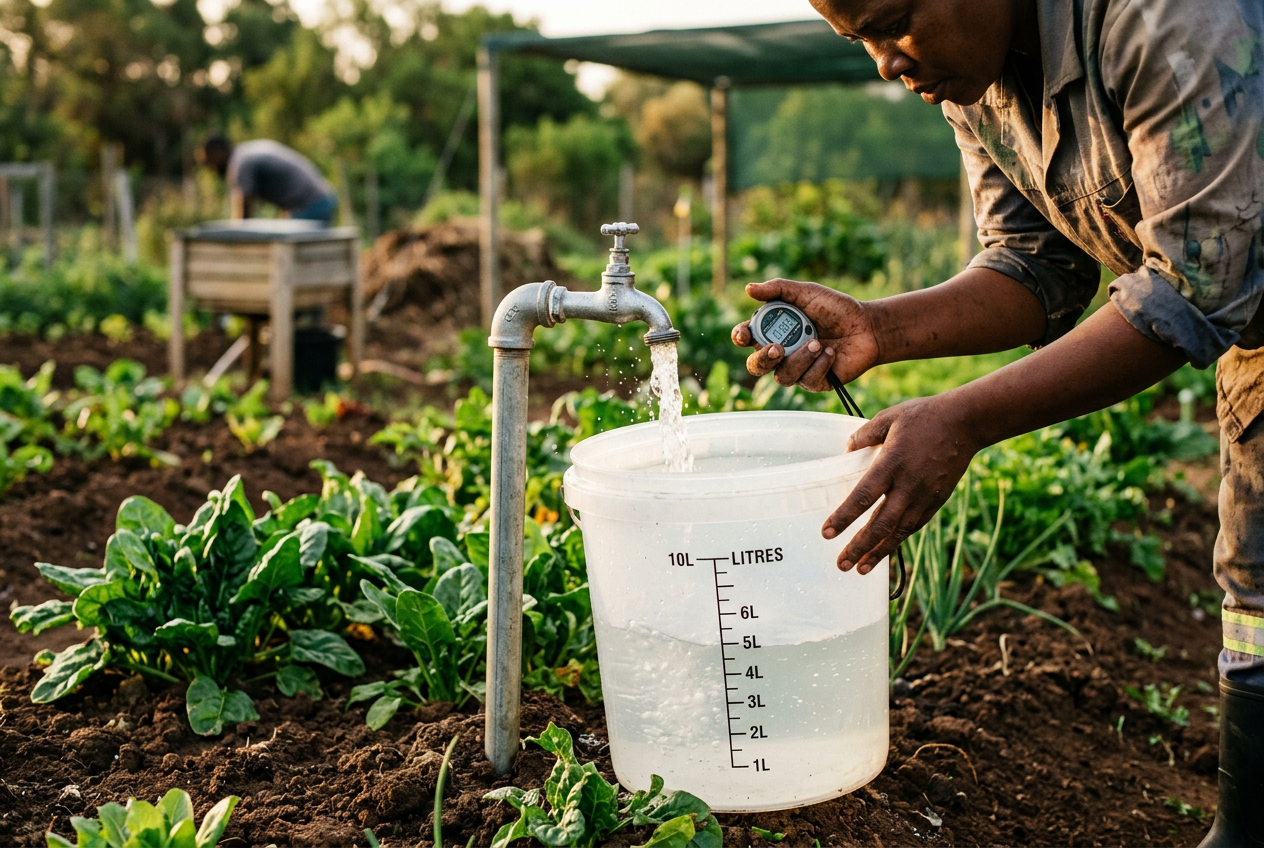
If a ten-litre bucket fills in thirty seconds, the source delivered water at that point and at that moment. That simple observation is useful. It is not a promise that the source will maintain the same flow through a filter, long pipe, elevation change and operating irrigation zone. The common trap is turning a screening test into a full design assumption.
Use the bucket method to produce a repeatable litres-per-minute record, then pair it with working-pressure and site information. It is a data-gathering tool, not a licence to select pipe sizes or combine every emitter on one valve.
For professional verification and zone design, see Green Earth Concepts irrigation systems.
The calculation is simple; the conditions are the real work
Flow is volume divided by time. When the measured container volume is in litres and time is in seconds, litres per minute equals litres multiplied by 60, divided by seconds. A 10-litre fill in 30 seconds is therefore 20 litres per minute. Record the container's verified fill line, not its nominal label, and keep all units visible in the calculation.
Repeat the test because municipal pressure, tank level, pump cycling and competing use can change the result. Note the time, source, valve position and whether taps, toilets, appliances or other irrigation were operating. Do not deliberately waste water: use the smallest safe, accurately marked container that gives a measurable time, and reuse the collected water.
Gravity-fed and pumped sources need additional context. A tank level can change both available head and test result; a pump may cycle, throttle or stop as demand changes. Never defeat a safety control to obtain a number. When the source behaviour is unstable, give the complete time series to the pump or irrigation specialist instead of selecting the highest reading as the design value.
Timing accuracy matters most when the fill is fast. If a small container fills in only a few seconds, reaction time can materially change the calculation. Use a larger safe volume, reduce avoidable turbulence or repeat more carefully rather than reporting false precision.
The next linked measurement is pressure. Read static and dynamic irrigation pressure explained before interpreting a strong-looking flow result. For the next practical decision, continue with How Many Irrigation Zones Do You Need? A Demand-and-Hydrozoning Method.
Run a repeatable bucket flow test
- 01
Choose and verify the test point
Use the proposed irrigation connection where practical. Confirm that the water may be used and that discharge will not cause slipping, erosion or damage. A test at a different tap may not represent the intended connection.
- 02
Mark a known volume
Verify a clear fill line using a trusted measuring vessel. Ten litres is convenient but not mandatory. A container that fills almost instantly makes timing inaccurate; an oversized container may be unsafe to handle.
- 03
Prepare the stopwatch and record
Write the date, time, location, container volume, source condition and other water uses. Have one person operate the outlet and another time if that improves safety and accuracy.
- 04
Open the outlet consistently
Open it to the intended test position. Allow unstable air or pump startup behaviour to settle only when safe and relevant, then start timing as the container begins to receive the measured flow.
- 05
Stop at the fill line
Stop the timer when water reaches the verified mark. Close the outlet, move the container safely and use the water on a suitable planted area or other approved purpose.
- 06
Calculate litres per minute
Apply litres × 60 ÷ seconds. Keep the unrounded result in the record and round only for communication. Example: 8 litres in 24 seconds gives 8 × 60 ÷ 24 = 20 litres per minute.
- 07
Repeat under representative conditions
Run at least several comparable tests and include a relevant high-demand period where possible. Large variation is a finding that needs investigation, not a number to average away.
Example recording sheet
<p><em>Illustrative values only. They demonstrate recording and calculation; they are not a design allowance or acceptable range.</em></p>
| Test | Volume | Time | Calculated flow | Conditions |
|---|---|---|---|---|
| Morning 1 | 10 L | 30 s | 20 L/min | No known competing use |
| Morning 2 | 10 L | 33 s | 18.2 L/min | Kitchen tap briefly opened |
| Late afternoon | 10 L | 42 s | 14.3 L/min | Higher site demand |
Reject these weak test results
- The container volume was assumed rather than verified.
- Only one very fast test was recorded.
- The test point differs materially from the proposed connection.
- Other water uses and pump or tank conditions were not noted.
- The result is treated as proof of working pressure.
- The water was captured safely and reused appropriately.
Keep the number attached to its conditions
- Calculate litres × 60 ÷ seconds and show the units.
- Repeat the test and record other water demand.
- Reuse collected water and avoid unsafe overflow.
- Pair flow with working pressure before design.

Confirm usable flow before the final zone plan
Bring your test record, site sketch and water-source details to a Green Earth Concepts assessment. The team can check the result in context, identify missing measurements and design zones around the conditions the source can actually maintain.
Flow-test questions
What bucket size should I use?
Use a safely manageable, accurately marked volume that takes long enough to time reliably. The calculation works with any known litre value. Avoid lifting a heavy full container if decanting or a smaller test is safer.
Can I size an irrigation zone from the bucket result?
Not by itself. Zone design also needs working pressure, losses through components and pipe, elevation, emitter demand, source variability and a suitable margin. Use the result as an input for the designer.
Why repeat the test?
Water delivery can change with municipal demand, pump operation, tank level and simultaneous use. Repeats reveal whether the initial result is stable enough to inform further investigation.
A useful test is honest about its limits
The bucket method is valuable because it replaces a guess with a measured observation. Its strength disappears when that observation is stretched into a guarantee. Record it carefully, repeat it, then use it with pressure and site evidence.