
Plan from material clocks, not event names
For each stream, define how long it can remain at generation, central storage, transfer, active treatment and output storage under stated conditions. Consider temperature, liquids, odour, pests, vectors, public access, fire load, cross-contamination and process biology. A garden bin and a commercial food-waste room do not share one safe holding time.
The applicable organic-waste treatment norms or composting norms should be translated into site controls, records, emergency response and monitoring. The Occupational Health and Safety Act forms part of the worker-safety framework. Follow the site's risk assessments, safe work procedures and authorised emergency contacts; this article does not prescribe emergency entry, electrical work or spill response.
Use official South African Weather Service warnings as one input to readiness, while recognising that local conditions and access can deteriorate faster than a regional warning. Assign who checks forecasts, who can reduce intake and who confirms recovery.
For biological process symptoms, consult the compost troubleshooting guide. A contingency route must still isolate uncertain material and protect people; “add browns” is not a response to structural failure, unsafe gas, floodwater or unknown contamination.
Scenario-action matrix
| Loss or disruption | Early trigger | Immediate controlled decision | Recovery evidence |
|---|---|---|---|
| Missed collection | Provider warning or collection window missed | Stop or reduce intake at the defined storage limit; escalate and activate verified backup | Collection and acceptance records, cleaned area, capacity restored |
| Power loss | Scheduled outage, trip or equipment alarm | Move to approved passive or backup mode; isolate equipment and protect critical controls | Competent restart check, downtime and process-condition record |
| Storm or flood threat | Official warning, rising storage or blocked access | Secure loose material, protect clean-water separation and suspend unsafe movement | Post-storm inspection, containment check and corrective actions |
| Operator absence | No competent person at handover | Run only the defined low-risk mode or stop intake; call trained backup | Signed handover and competency-confirmed restart |
| Process or destination failure | Out-of-range condition, rejection or facility closure | Quarantine affected material; stop claims and route through approved contingency | Investigation, authorised destination and release decision |
| Pest or odour escalation | Threshold or substantiated complaint exceeded | Control new intake, secure source and escalate to competent response | Inspection trend, complaint closure and verified corrective action |
Write a plan people can use during a disrupted shift
- 01
Map single points of failure
List sole operators, vehicles, power-dependent controls, pumps, access roads, storage areas, receivers, communications and utilities. Mark dependencies hidden in subcontractors.
- 02
Set numeric or observable triggers
Use approved storage level, missed window, tank level, weather alert, process range, complaint threshold or staff cover. Avoid 'when serious', which leaves every shift to negotiate.
- 03
Give decision authority
Name who may stop intake, redirect a load, call backup, notify authorities or clients, approve spending and restart. Provide an alternate and after-hours route.
- 04
Pre-verify backup destinations
Check accepted material, approval scope, capacity, transport, hours, price and records before the ordinary destination fails. A phone number is not contingency capacity.
- 05
Prepare safe low-power operation
Identify controls that can safely become passive, those requiring backup and those that require shutdown. Qualified specialists must design electrical, ventilation, pumping and equipment procedures.
- 06
Protect records and communication
Keep accessible contacts, current material inventory, incident forms and manual movement records. Define who tells staff, contractors, neighbours, clients and authorities what and when.
- 07
Drill one failure at a time
Run a tabletop followed by a safe operational test where appropriate. Time decisions, find missing keys or contacts and confirm that the backup actually accepts a sample record.
- 08
Recover deliberately
Inspect, reconcile material, investigate cause, approve restart and monitor the first operating period. Do not clear the incident merely because collection resumes.
Record the disruption as evidence for redesign
Open one event log when the trigger is reached. Capture start time, material and capacity at risk, weather or service conditions, decisions, notifications, destination changes, photographs where authorised, costs and the person who approved restart. Keep estimates labelled and reconcile them when movement records arrive. The log should help the next shift act, not become a blame document.
Review the event at three levels. First, did people follow the plan and stay within safe authority? Second, did the plan provide realistic capacity, contacts and actions? Third, did design or contract decisions create the failure—for example, one receiver, inaccessible isolation, no relief operator or a storage limit smaller than the collection interval? Correct the system as well as the immediate symptom.
Track repeat events and near misses by cause, location, stream and shift. A pattern of small missed collections or tank-high warnings deserves action before it becomes an emergency. Close corrective actions only with evidence such as a changed route, tested backup, repaired asset, revised trigger or demonstrated competency.
Issue role cards for the first critical period. The shift operator identifies the trigger and makes the area safe within trained authority; the supervisor confirms material limits and staffing; the service owner activates the pre-verified provider or destination; the safety or environmental role handles required escalation; and communications uses approved facts. Each card should name a deputy and the point at which normal authority ends. A phone tree with no decision rights merely passes anxiety around.
Pre-agree what cannot be improvised. Examples include bypassing containment, mixing unknown material into a clean stream, energising equipment through an unauthorised connection, entering an unsafe space, sending a rejected load to an unnamed destination or restarting before capacity is confirmed. Put those prohibitions beside the trigger, not deep in a manual. If a safe route is unavailable, the plan may need to reduce or stop generation-side acceptance rather than force continued throughput.
Exercise one scenario at a time and preserve ordinary operations. A tabletop can test contacts and decisions; a supervised drill can test a hand-off, backup pump or alternate collection within approved procedures. Record elapsed times, missing information and unsafe assumptions, then revise the plan and retest. Never create a spill, overload, food-safety risk or unapproved discharge simply to make a drill feel realistic.
Include contractors and relief staff in the test when their decisions affect the route. A plan known only to permanent managers will fail on the weekend or night shift where the first trigger may appear.
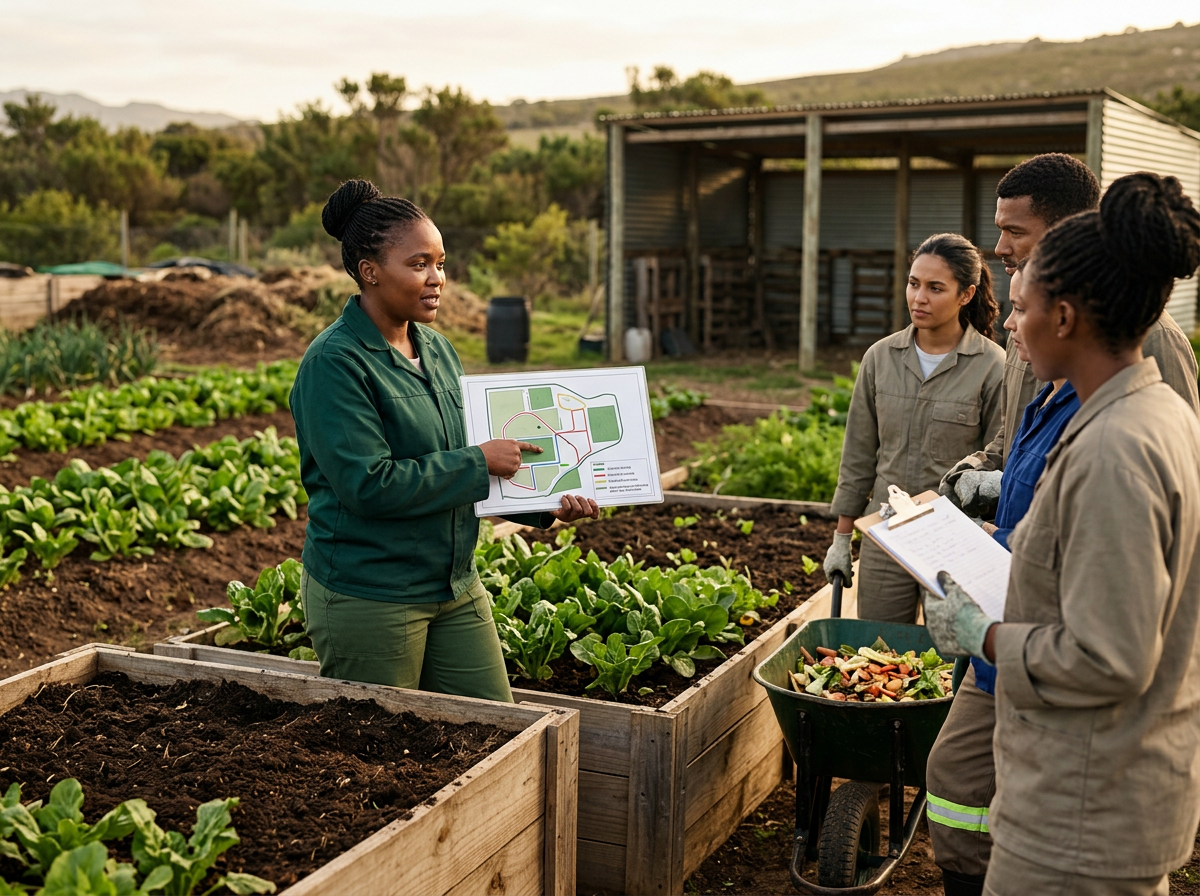
Map capacity boundaries and alternate routes before a disruption
Place stop points before the site becomes crowded
The visual shows a woman facility manager leading a tabletop around a physical site model: generation, storage, process and destination each have a visible capacity boundary and an alternate route. Storm and power disruptions are represented by conditions, not dramatic rescue scenes. The plan supports decisions; trained responders and site procedures govern real emergencies.
Add a pest escalation branch using the organic-waste pest-prevention guide. Prevention, observation and source correction belong in routine work so that contingency is not reduced to reactive chemical treatment.
Ten-minute shift readiness check
- ✅ Current material and remaining safe approved capacity are known.
- ✅ The operator and backup can be contacted and have decision authority.
- ✅ Power, water, access, storage, equipment and collection status were checked.
- ✅ Backup receiver availability is verified, not assumed.
- ✅ Weather, complaint and process triggers are visible to the shift.
- ❌ Do not accept new material after a stop trigger because a truck may arrive later.
Organic-waste contingency questions
How much emergency storage is enough?
There is no universal volume. Use peak inflow, material risk, site conditions, collection and treatment recovery time, weather, approvals and safe operating limits, with competent design review.
Can general waste be the backup route?
Only if the route is lawful, accepted, safe and consistent with site and contract conditions. Pre-verify the destination and keep honest records; do not report that load as recycled.
Should equipment run on a generator during load-shedding?
Only where qualified electrical and equipment specialists have designed and approved that mode, with fuel, ventilation, changeover, maintenance and safe shutdown addressed.
When can intake restart?
After a named competent person confirms capacity, containment, staffing, equipment, destination and required notifications or corrective actions. Monitor the first cycle and retain the decision.
Test the bad day before it arrives
Green Earth Concepts can map material clocks, capacity, dependencies and backup routes, then facilitate a site-specific tabletop and controlled pilot with the operations team. Bring provider contacts, site limits, process records, incident history and current emergency procedures.
Resilience is a limit the team is willing to enforce
A contingency plan becomes real when operators know the trigger, have authority to stop intake and can activate an already verified route. Design for lost power, access, people, equipment and destination; then rehearse recovery. The strongest evidence is not a binder—it is a shift that stays controlled when the ordinary system disappears.