
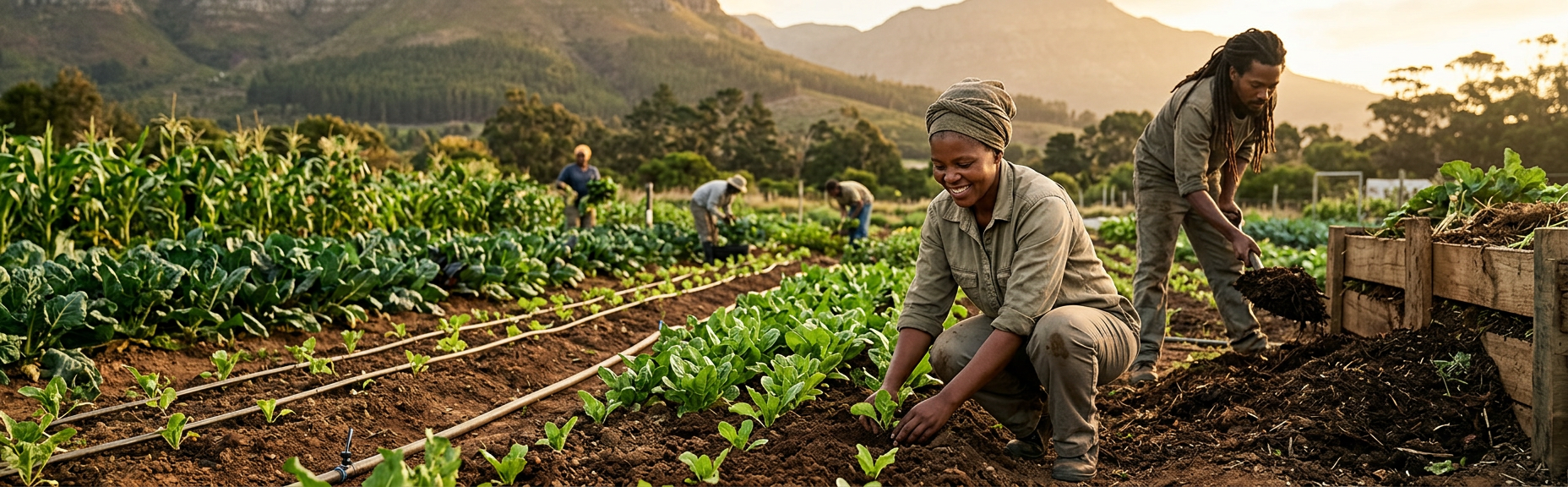
Sustainability begins when the system has to work on Monday morning
Sustainable agriculture can sound like a collection of good intentions: save water, improve the soil, grow healthy food and involve the community. Those intentions matter, but they do not yet make a working farm or food garden. A working system must answer practical questions. Where will the water come from? What happens during a hot, dry week? Who checks the irrigation? Which crops suit the soil and season? Where will compost come from, and how will its quality be checked? Who harvests when the project leader is away?
In South Africa, these questions are especially important because growing conditions vary sharply between regions and even between sites in the same town. A winter-rainfall garden near Cape Town, a frost-prone Highveld school and a humid KwaZulu-Natal smallholding should not receive the same calendar or design. Sustainable agriculture is therefore not a fixed recipe. It is a way of designing and managing a growing system around its land, climate, water, people and purpose.
This guide gives you a five-part framework for making that idea concrete. Use it to assess a household food garden, a school project, a community site or the first pilot area on a farm. For site-specific design and implementation, explore sustainable agriculture systems.
The five parts of a sustainable growing system
1. Soil that can keep improving
Productive soil is more than a place that holds roots. Its structure affects drainage, air, rooting depth and how long water remains available. Organic matter and surface cover can support soil structure and biological activity, but inputs must be clean, mature and appropriate for the crop and site. A sustainable plan begins by observing and, where needed, testing the soil before applying lime, fertiliser, compost or other amendments.
2. Water used intentionally
Water-wise farming means delivering suitable water to the root zone at a rate and frequency the soil can accept. It includes source reliability, water quality, storage, pressure, zoning, irrigation method, mulch and operator checks. Drip irrigation may suit rows and beds, while other zones may need different methods. No component is automatically efficient when pressure, filtration, scheduling or maintenance is wrong.
3. Crops matched to place and purpose
A garden for household nutrition, a chef garden and a market garden have different crop priorities. Crop selection should consider season, frost and heat risk, days to harvest, space, rotation, seed or seedling availability, water demand, labour and how the harvest will be used. Current local production guidance is more reliable than a generic national planting graphic.
4. People with clear roles and practical skills
Infrastructure cannot compensate for unclear ownership. A school needs a holiday-care plan. A community garden needs agreements about water, tools, access and harvests. A farm needs operators who can recognise pressure changes, blocked emitters and crop stress. Practical demonstrations, simple records and a named escalation route are part of the design, not an optional extra.
5. A model that remains viable
A system should fit the budget, available time and maintenance capacity. Count both once-off and recurring needs: bed materials, water infrastructure, seed, seedlings, soil inputs, tools, repairs and labour. Benefits may include food, learning, staff participation or a more useful landscape, but they should not be presented as guaranteed yield or return. Start with a manageable area, record what happens and expand on evidence.
For the next practical decision, continue with food garden site assessment checklist.
For the next practical decision, continue with build soil organic matter with compost and mulch.
For the next practical decision, continue with conservation agriculture transition for small farms.
From a green idea to a testable design brief
<p><em>A useful design brief connects every sustainability claim to evidence and an operating decision.</em></p>
| Question | Evidence to collect | Decision it informs |
|---|---|---|
| What can this soil support? | Texture, drainage, rooting depth, pH or laboratory results where appropriate | Bed type, crop choice and soil-improvement plan |
| How reliable is the water? | Source, seasonal availability, flow, pressure, quality and applicable restrictions | Irrigation method, area, storage and priority zones |
| What is the growing purpose? | Household use, learning, community need, menu demand or market plan | Crop mix, planting rhythm and harvest process |
| Who will operate it? | Named roles, weekly time, existing skills and holiday or staff-cover plan | System complexity, training and maintenance schedule |
| How will progress be judged? | Baseline photos, bed area, input records, harvest records and task completion | Pilot review, correction and scale-up decision |
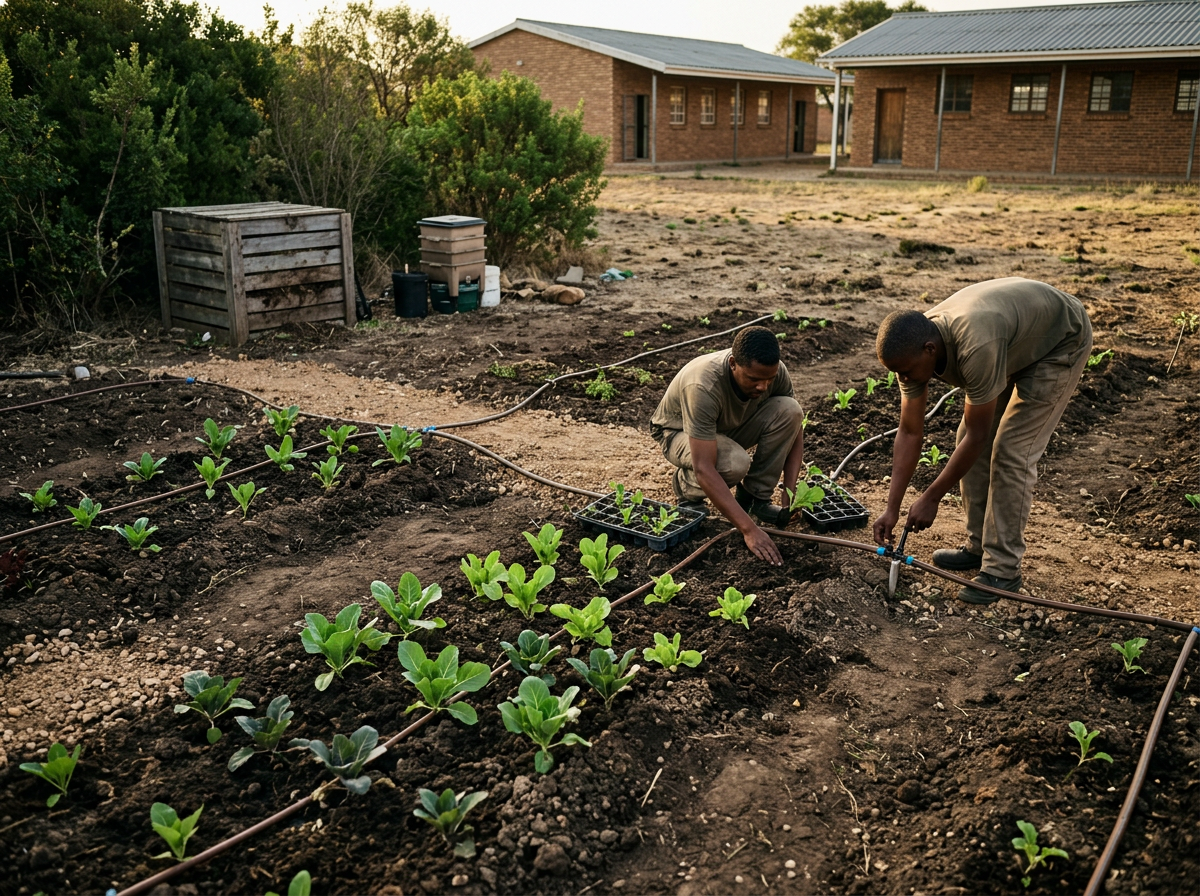
School site plan changing from unused ground to a small food-garden pilot with safe paths and irrigation
A practical example: redesigning an underused school corner
Imagine a school that wants to turn an unused patch into a food garden. The first idea is to install many raised beds immediately. A site walk changes the plan. Part of the area is shaded by buildings in winter, a downpipe causes erosion in heavy rain, the nearest tap has limited flow and the grounds team is already stretched. None of these findings means the project should stop. They mean the first phase should be designed differently.
The team maps the reliably sunny area, checks drainage and creates a smaller pilot with wide, safe paths. The beds are grouped into one manageable irrigation zone. Roof runoff is directed safely rather than allowed to scour the site. The crop list favours plants suited to the available season and the school's learning goals. A teacher, grounds-team member and learner group receive role-based training, while adults retain responsibility for tools, water controls and food-safety decisions.
The pilot is reviewed after a full growing cycle. The school records maintenance time, water-system problems, learning activities and what was actually harvested. Expansion is then based on evidence, not the excitement of launch day. That is sustainable agriculture in practice: a system shaped to the site and the people who must keep it working.
Five tests to apply before calling a project sustainable
- Soil test — Can the team explain how the design protects soil, manages drainage and uses inputs responsibly?
- Water test — Is the growing area compatible with the source, delivery capacity, restrictions and likely dry-period priorities?
- Crop test — Do the crops fit the local season, space, purpose and realistic harvest process?
- People test — Are roles, routines, training, safety and cover for absence clear?
- Viability test — Can the site maintain recurring inputs and repairs, and will expansion depend on measured results?
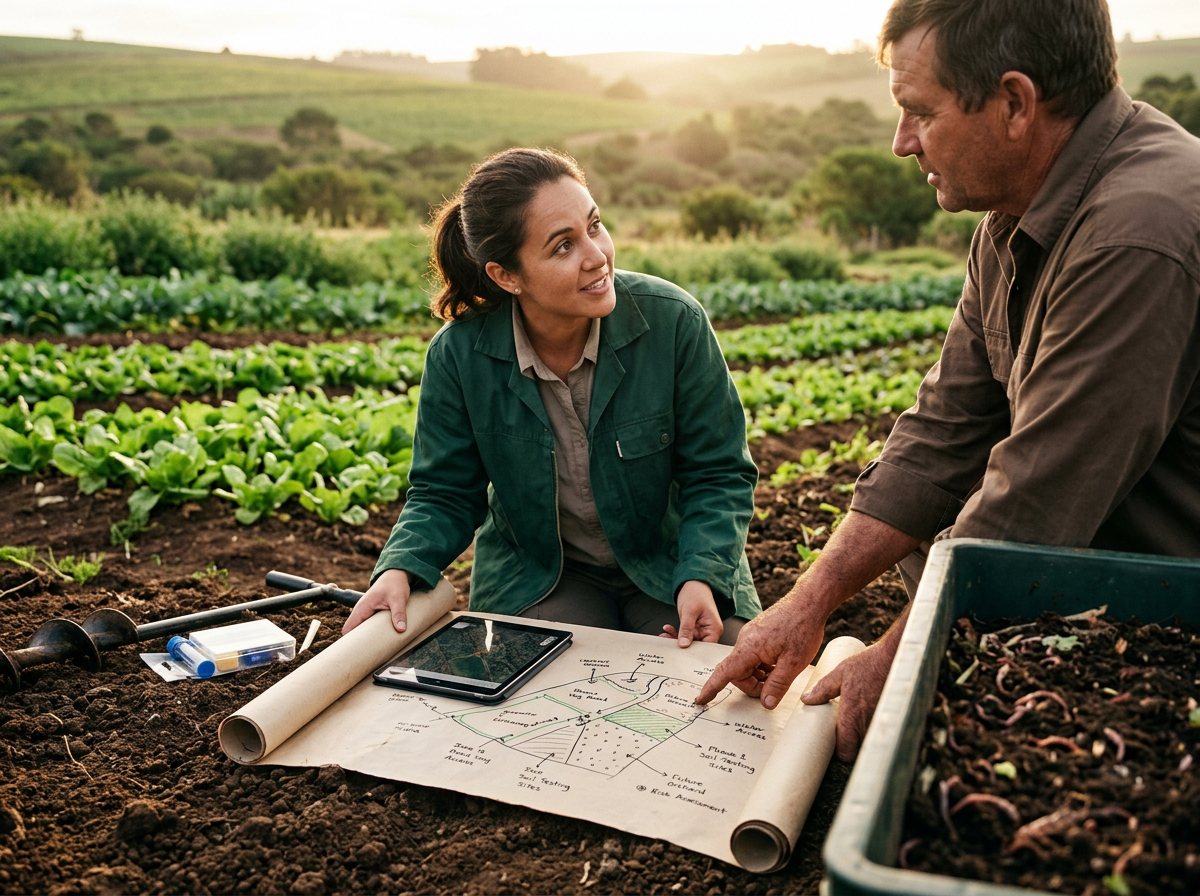
Turn the principles into a plan for your land
Green Earth Concepts assesses the land, soil, water access, layout, goals and maintenance capacity behind a proposed growing system. The result is a clearer basis for deciding what to build now, what to phase later and what risks need attention before money is committed.
What to remember
- Sustainable agriculture is a managed relationship between soil, water, crops, people and viability—not a label attached to one product.
- South African growing advice must be localised for rainfall pattern, frost, heat, soil, water access and the purpose of the project.
- Start with observation and a site assessment before choosing bed materials, irrigation hardware or crop quantities.
- Build operator skill, maintenance access and simple records into the design from the beginning.
- Pilot at a manageable scale, review a full cycle and expand only when the evidence and team capacity support it.
A sustainable system is one that can be understood, maintained and improved
Healthy soil, careful water use and diverse crops are essential, but they only endure when people can operate the system and the scope fits real resources. The strongest starting point is not the largest garden. It is the clearest design brief, the most relevant pilot and a team that knows what to observe next.
Treat sustainability as a process of learning from the site. Measure before amending, group plants before zoning water, train before handover and review before expanding. That turns a worthy ambition into a growing system with a realistic chance of lasting value.